It’s my birthday this week, and as I reflect on a long and wonderfully varied career, I’ve been thinking about the things I wish I’d known when I was younger.
I’ve spent much of my life in communications. First as a public relations executive and broadcaster, and later as a public speaking coach helping leaders, professionals, and even celebrities find their voices.
You might think that during all these years, I would have figured it all out. Not even close. Some of my most valuable lessons came from mistakes, uncomfortable moments, unlearning bad advice, and discovering that what works in front of a television camera doesn’t necessarily work in front of a live audience.
And as someone who struggled with stuttering early in life, I’ve learned that the road to becoming a confident communicator is rarely straight or smooth.
In the spirit of another trip around the sun, here are 13 things I wish someone had told me about public speaking earlier in my career. Perhaps they’ll save you a few detours of your own.
1. Never imagine your audience naked.
Whoever invented this advice clearly didn’t think it through. Imagining an auditorium full of naked people is disrespectful to them and more likely to distract you than calm your nerves. Instead, imagine your audience as people who genuinely want you to succeed. They’re there to learn something, solve a problem, or be inspired. Focus on serving them, not fearing them.
2. You’re the lead singer. Your slides are the backup chorus.
PowerPoint is not the star of your presentation. You are. Slides should reinforce, illustrate, and amplify your message, not compete with it. If your audience spends more time reading your slides than listening to you, you’ve surrendered the spotlight.
3. Confidence isn’t something you’re born with. It’s something you build.
Composure comes from preparation, repetition, and experience. Actors rehearse. Athletes train. Musicians practice their instruments. Why should speakers expect to perform brilliantly without doing the same? Confidence is earned, one rehearsal at a time.
4. A television camera is less intimidating than a live audience.
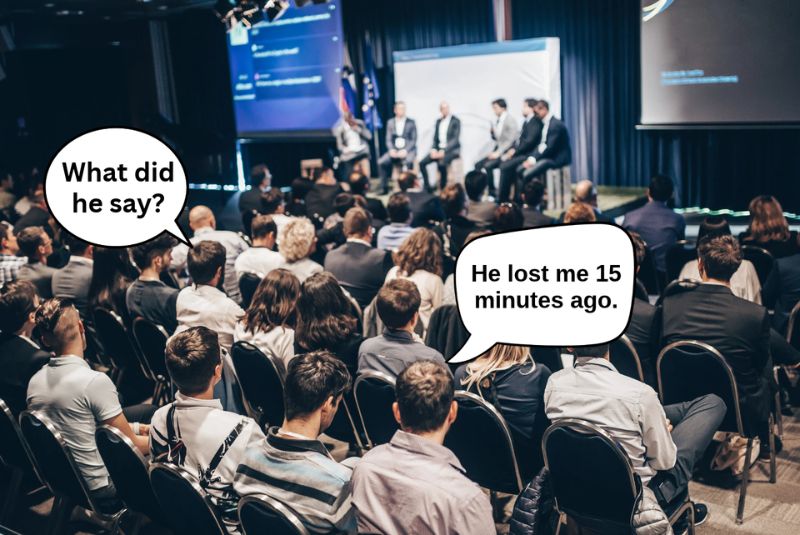
I learned this firsthand. The camera, the “one-eyed monster,” doesn’t yawn, frown, check its phone, or stare at you with a puzzled expression. A live audience gives you immediate feedback, sometimes when you least expect it. Learning to read the room and adapt in real time is a skill that no amount of television experience can replace.
5. Silence is part of your speech.
Early in my career, I thought every second of silence needed to be filled. Now I know that pauses can be among the most powerful tools a speaker possesses. Silence creates anticipation, gives ideas room to breathe, and allows listeners to absorb what you’ve said. Don’t fear the pause. Own it. It also helps to counter pesky filler words.
6. Your breath is the engine that powers your speech.
Breathing is the foundation of vocal power, control, and composure. When nerves take over, breathing often becomes shallow and rapid. Learning to breathe efficiently can steady your delivery, support your voice, and help you regain control when anxiety strikes.
7. Your hands are not the enemy. Let them speak, too.
I wish someone had told me to stop worrying about what to do with my hands when speaking. Should I clasp them? Keep them in my pockets? Put them behind my back? The answer is none of the above. Your hands are natural extensions of your thoughts and words, like physical emojis. They can emphasize a point, illustrate an idea, convey emotion, and make your message more memorable. The secret is to let them move naturally and purposefully. And when your hands have nothing to say, it’s perfectly fine to let them rest.
8. Great speaking requires three M’s: Mind, Matter, and Manner.
Mind is your mindset: your confidence, intention, and emotional readiness. Matter is your content: what you say and why it matters. Manner is your delivery: how you use your voice, body, and presence. Neglect any one of these, and your message suffers.
9. Your speech isn’t about you.
This may be the most important lesson of all. A successful presentation isn’t measured by how much applause you receive or how impressive you appear. It’s measured by what your audience understands, remembers, feels, and does as a result. Shift your attention from being admired to being useful.
10. Never apologize for your accent.
I’ve coached executives who speak English as their second or third language and worry that their accents diminish their authority. They don’t. An accent tells a story of language, culture, and experience. The goal isn’t to erase it but to be understood. Your accent can be part of your superpower.
11. Perfection is the enemy of connection.
I wish I’d known sooner that audiences don’t need flawless speakers. They need human ones. A forgotten word, an unexpected laugh, or a moment of vulnerability can create more connection than a perfectly memorized script. Strive for excellence, certainly. But don’t sacrifice authenticity on the altar of perfection.
12. You don’t have to be an extrovert to command a room.
Some of the most compelling speakers I’ve coached are naturally quiet, reflective people. They listen carefully, prepare thoughtfully, and speak with intention. Public speaking isn’t a contest to see who has the biggest personality. It’s an opportunity to make your ideas matter.
13. Your greatest perceived weakness may become your greatest strength.
For years, I regarded my stutter as an obstacle to the career I wanted. I couldn’t have imagined that one day I’d stand on a TEDx stage and talk about how stuttering became my superpower. That experience taught me empathy, resilience, discipline, and the value of every word. Sometimes the very thing we struggle to overcome becomes the source of our greatest contribution.
The gift of hindsight.
Birthdays have a way of making us take stock. We look back at the milestones, the mistakes, the people who shaped us, and the lessons that took years to understand.
If I could go back and speak to my younger self, I’d tell her to worry less about sounding perfect and more about being understood. To trust her voice, even when it falters. To rehearse more, listen better, pause longer, and remember that communication is not a performance of self-importance but an act of connection.
And I’d remind her that becoming a great communicator isn’t a destination. It’s a lifelong practice. After all these years, I’m still learning.
Here’s to another year of learning, growing, and finding our voices.