Do not start a presentation with your name. Start with a preview, a promise, and a plan for what’s in it for them. Let me explain.
The first words of a presentation carry an unfair amount of weight. In the opening minute, your audience decides whether you are relevant, credible, and worth their attention. Yet many speakers waste that valuable moment with a long thank-you, a biography, or the predictable phrase, “My name is…and today, I’m going to talk about…”
A strong opening does something more useful: it answers the question already forming in every listener’s mind: why should I care?
I teach speakers to begin with their audience, not themselves. That does not always require a dramatic story, a startling statistic, or a clever quotation (though those are wonderful, too). Sometimes the most effective opening is a clear, compact road map.
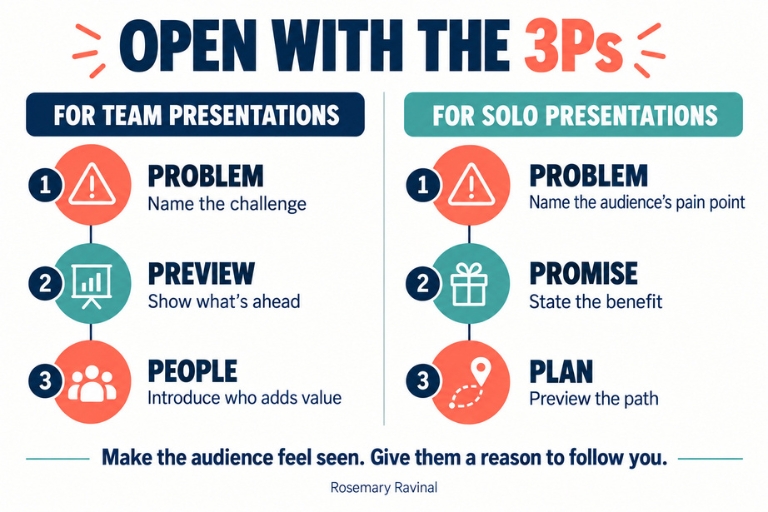
Two versions of the 3Ps can help you create one: Problem- Preview-People and Problem-Promise-Plan.
Problem. Preview. People.
This structure is especially useful for team presentations, client pitches, conferences, and meetings with multiple speakers.
Problem names the challenge, tension, or opportunity that matters to the audience. Preview tells listeners what they will hear and why it is relevant. People introduces the colleagues or experts who will contribute later by explaining the value each person brings.
For example, imagine the opening of a presentation about improving the customer experience:
Problem: Our customers are waiting too long for answers, and every delay puts their trust and our revenue at risk.
Preview: Today, we’ll show you where the experience breaks down and the three changes that can make service faster and more personal.
People: Maya will walk you through what customers told us. Daniel will explain the technology fix. I’ll close with the implementation timeline and the decisions we need from you today.
Notice what this opening accomplishes. It establishes urgency, provides a clear preview and positions every speaker as part of one coordinated story. The team introductions serve the audience instead of interrupting the momentum.
Problem. Promise, Plan.
The second version of the 3Ps works beautifully for a keynote, workshop, sales conversation or solo presentation. It tells the audience: I understand what is difficult, I know what improvement looks like, and I have a way to help you get there.
Problem identifies the audience’s pain point. Promise describes the benefit they can expect from listening. Plan previews the path you will take together. Note that the promise should be specific and credible, not an exaggerated claim you cannot deliver.
Here is an example for a presentation on executive communication:
Problem: Many brilliant leaders lose their audience because they give people everything they know instead of what people need.
Promise: In the next 30 minutes, you’ll learn how to make complex ideas clear, concise, and memorable.
Plan: We’ll focus on three moves: identify what your audience needs to think, feel, and do; organize your message around one central idea; and deliver it with a confident voice and body language.
The listener immediately understands the problem, the payoff, and the journey ahead. That creates attention and trust.
Your opening is a contract.
Whether you use Problem-Preview-People or Problem-Promise-Plan, keep the opening conversational and brief. Do not overload it with background or try to solve the entire problem before the presentation has begun. Create enough tension to make people want the answer, then show them where you are taking them.
Most important, deliver on what you preview or promise. Your opening is a contract with the audience. If you promise three ideas, give them three ideas. If you introduce a team, make the transitions feel seamless. And if you name a problem, return to it in your conclusion and show what has changed.
Open with purpose. Make the audience feel seen. Then give them a reason to follow.
To learn more about effective speech openings, watch my YouTube video, How to Open a Speech with Confidence. Subscribe for updated tips and techniques to deliver your presentations with ease, confidence, and impact. Follow me on Instagram for weekly reels, and search this blog for hundreds of useful articles on communication excellence.