
Have you ever listened to someone speak and thought, Where is this going?
They may be brilliant and know their subject inside and out. They may have something important to say. But without structure, their ideas arrive like a box of puzzle pieces dumped on a table, and the audience is tasked with assembling them into a picture that makes sense.
One of the most important lessons I teach my coaching clients is deceptively simple: Effective communication has architecture. Whether you’re answering a question in a meeting, pitching an idea, making an argument, giving a presentation, or speaking to the media, structure helps your audience follow your thinking and remember it.
Structure isn’t a straitjacket
Some speakers resist frameworks because they fear sounding formulaic. They want to sound spontaneous and conversational. “I’m an expert on this topic, so I’ll wing it.” I love frameworks because they make structure and spontaneity peas in the pod of a great talk.
Think about jazz. The musicians can improvise brilliantly because there’s an underlying structure holding everything together. Communication works the same way. A framework gives you something solid to stand on so you can speak more freely. It also reduces the mental burden on the speaker. Instead of thinking, “What do I say next?” you already know where you’re going.
Three simple frameworks illustrate this beautifully.
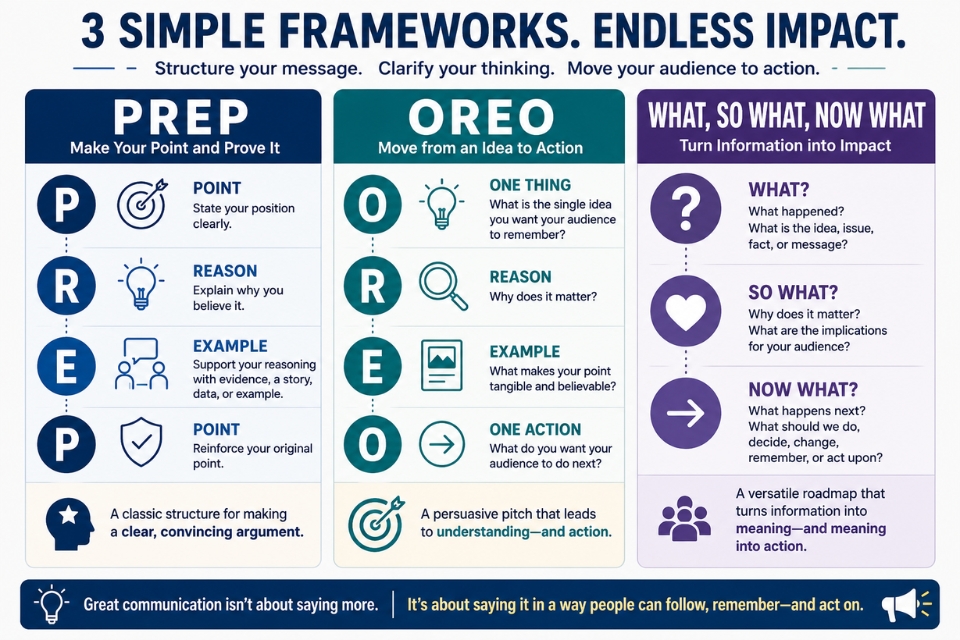
PREP: Make your point and prove it
PREP is a framework commonly taught for persuasive and extemporaneous speaking and is particularly useful in settings where you need to make a concise argument. That’s why it’s often taught in law schools.
P — Point
State your position clearly.
R — Reason
Explain why you believe it.
E — Example
Support your reasoning with evidence, a story, data, or a concrete example.
P — Point
Return to your original point and reinforce it.
You’ve heard the classic speaker’s maxim, Tell them what you’re going to tell them; tell them; then tell them what you told them. PREP adds reason and evidence to that familiar architecture.
Imagine you’re asked in a leadership meeting: “Should we require employees to spend more time in the office?” Without structure, you might start thinking aloud: productivity, culture, commuting, collaboration, employee preferences. And soon your answer is wandering in five directions.
PREP forces clarity:
Point: “I believe teams should have regular in-person time together.”
Reason: “Because certain kinds of collaboration and relationship-building happen more naturally face-to-face.”
Example: “When our team met in person for last month’s planning session, we resolved issues in two hours that had been circulating on email for weeks.”
Point: “That’s why I favor purposeful in-person collaboration rather than simply mandating office attendance.”
The framework made the argument easy to follow, not robotic.
OREO: Move from an idea to action
Another memorable framework, associated with keynote speaker Akash Karia, is OREO:
O — One thing
What is the single idea you want your audience to remember?
R — Reason
Why does it matter?
E — Example
What makes your point tangible and believable?
O — One action
What do you want your audience to do next?
OREO is particularly powerful for pitches and business presentations because it moves beyond making a point to creating action.
Suppose you’re pitching your CEO on investing in presentation coaching for senior leaders.
One thing: “Our senior leaders need to become stronger communicators.”
Reason: “Because their ability to explain strategy clearly directly affects employee confidence and execution.”
Example: “We saw during the last town hall that several employee questions resulted from confusion about priorities, not disagreement with them.”
One action: “Let’s create a communication coaching program for the leadership team before the next company-wide meeting.”
There’s your pitch framework. No mountain of background information before getting to the point.
W-SW-NW: The Swiss Army knife of frameworks
My favorite framework, What? So What? Now What? and OREO share the same DNA: both move an audience from idea to meaning to action. The difference is emphasis. OREO asks you to support your central idea with reason and concrete evidence before calling for action.
W- SW-NW is broader and more versatile. It moves from information (What?) to relevance (So What?) to action (Now What?), making it ideal for executive updates, presentations, meetings, emails, and spontaneous answers. Think of OREO as a compact persuasive pitch and W-SW- NW as an all-purpose roadmap for turning information into meaning and meaning into action.
For example:
What? “Customer complaints increased 20 percent this quarter.”
So What? “If the trend continues, we risk losing some of our most loyal customers and damaging our reputation.”
Now What? “Let’s identify the three biggest sources of complaints and present an action plan by Friday.”
Your audience needs a mental map
This is the larger principle behind PREP; OREO; W-SW-NW and other communication frameworks: the human brain likes patterns. Listeners are constantly trying to determine where information belongs and what matters most. Structure provides a mental map.
It also helps you resist one of the most common mistakes I see among smart, accomplished professionals: thinking aloud instead of communicating. Thinking is messy, but communication shouldn’t be.
That means deciding: What is my point? Why should they care? What will make it credible or memorable? What should happen next?
Build the container before filling it
Before your next presentation, pitch, difficult conversation, or high-stakes meeting, resist the temptation to immediately start writing sentences, building slides, or worse still, freestyling.
Choose the container then fill it. The difference between someone who knows a lot and someone who communicates powerfully often isn’t intelligence, expertise, vocabulary, or charisma. It has to do with structure.
When your thinking has structure, your audience doesn’t have to work to understand you. They can spend their energy deciding whether to believe you, remember you, and act on what you said.
And here is the biggest payoff: You won’t have to work as hard. Your arguments will flow, and you will achieve higher levels of confidence and success every time you speak.